



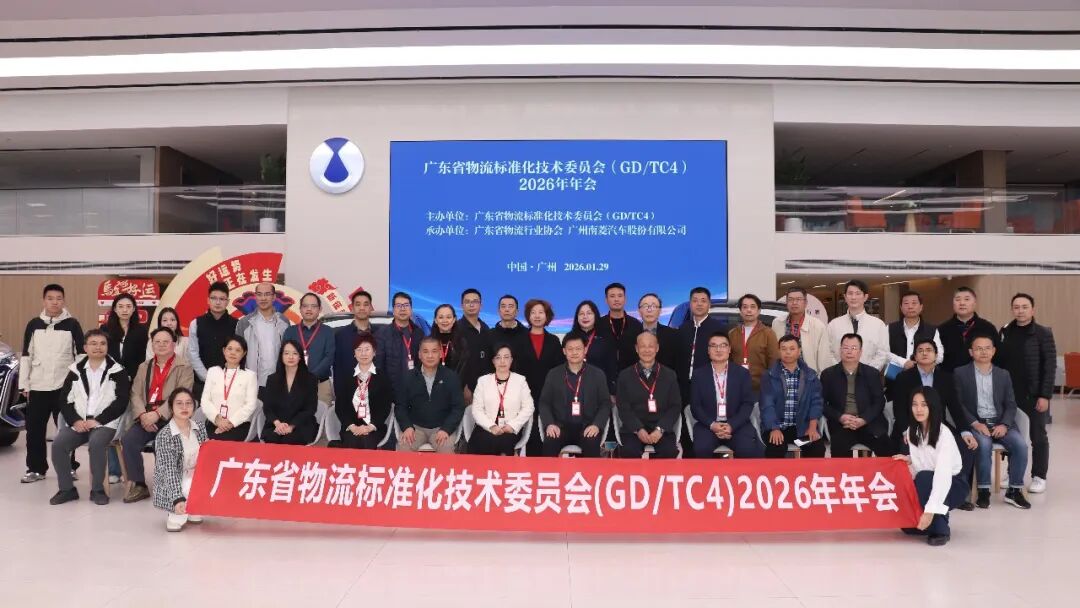
On January 29, the 2026 Annual Conference of Guangdong Logistics Standardization Technical Committee (GD/TC4) was held in Guangzhou. Huang Zhenghong, Executive Director of Hong Kong Yuhu Group, Vice Chairman of GD/TC4 and Member of the Chinese Expert Group of ISO/TC 315, was invited to attend the conference and deliver a keynote speech. At the conference, he not only introduced the latest progress and developments of multiple proposals in the field of international cold chain logistics standardization, but also focused on sharing the breakthrough achievements and practical experience of China leading the formulation of key international standards, providing cutting-edge and systematic industry insights for attending committee members and enterprise representatives.
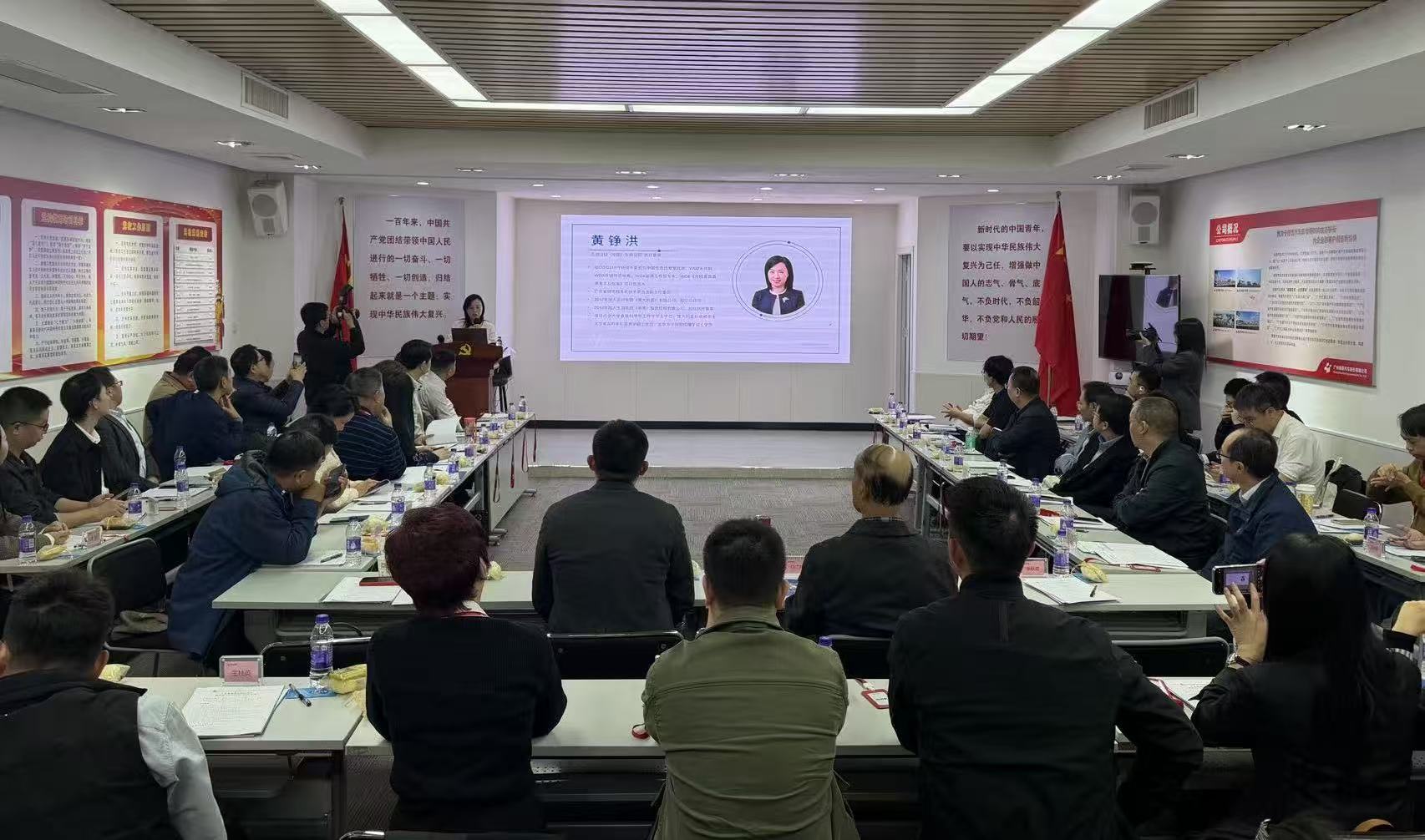
The annual conference included six main agendas, covering professional training and cutting-edge technology lectures, 2025 work summary, interpretation of Measures for the Administration of Professional Standardization Technical Committees of Guangdong Provincial Administration for Market Regulation, adjustment and supplement of committee members, proposal of suggestions for next-step work, and arrangement of the 2026 work plan. The conference comprehensively reviewed the work achievements of GD/TC4 in the field of logistics standardization in 2025, conducted in-depth analysis of the new situation and challenges currently faced, and clarified the direction and goals of logistics standard construction in the future. A total of nearly 60 participants attended the conference, including 43 committee members of GD/TC4 and representatives from some enterprises.
Latest Trends in the Development of Global Cold Chain Standards
At the conference, Huang Zhenghong delivered a keynote speech titled Latest Progress of ISO/TC 315 International Standards for Cold Chain Logistics. He sorted out in detail the development and revision progress of a number of important standards, and systematically introduced the key trends and future directions in the current international cold chain logistics standardization field for attending committee members and enterprise representatives.
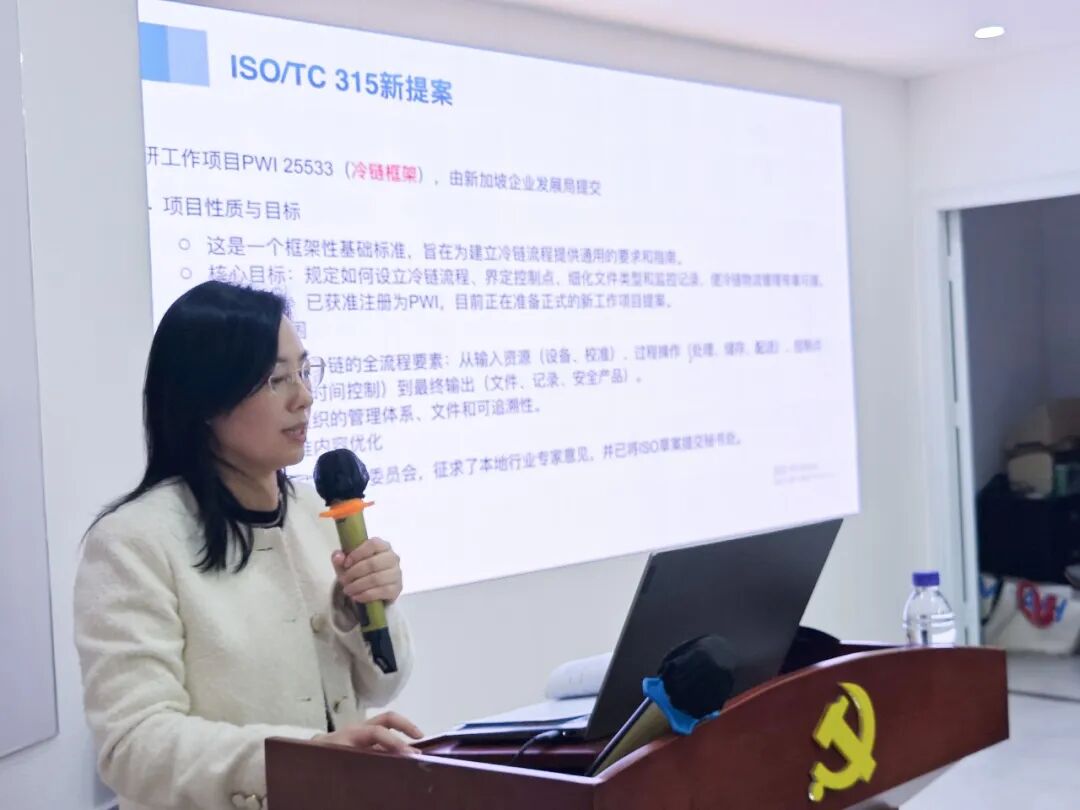
▲ Huang Zhenghong, Executive Director of Hong Kong Yuhu Group, Vice Chairman of GD/TC4, and Member of the Chinese Expert Group of ISO/TC 315
In terms of basic framework and optimization of existing standards, the Preliminary Work Item (PWI) 25533 Cold Chain Framework proposed by Singapore Enterprise Development Board aims to establish a set of general guidelines for setting up cold chain processes, covering the full-chain requirements from resource input, process operation to control points and document output, and is currently being advanced as a new work item proposal. For ISO 23412:2020 Temperature-controlled Refrigerated Parcel Delivery which has been implemented for five years, a revision proposal has been initiated. The revision will enhance the standard value, optimize the structure, integrate the concept of environmental management, and eliminate ambiguities in practice, so as to improve its applicability and certification consistency.
In terms of technology empowerment and green transformation, a new project proposed by China National Institute of Standardization will focus on the configuration requirements of facilities and equipment for contactless delivery, forming a hardware supplement to the existing service standards. Japanese experts put forward a new proposal on International Standards for Sustainable Cold Chain Logistics, providing a framework for emission reduction accounting and management systems. The technical report submitted by China focuses on the application of artificial intelligence in food traceability, offering principles and risk management guidelines for the responsible application of AI.
In terms of expanding key vertical industry standards, the proposal from Bureau of Indian Standards and management colleges focuses on the upstream post-harvest cold chain links of fresh agricultural products from farms to distribution centers. It aims to reduce post-harvest losses by up to 25-40% through standardized operation and service requirements, complementing the existing downstream standards. The new proposal submitted by Standardization Administration of China is intended to fill the gap in international standards for pharmaceutical cold chain, providing a unified and certifiable operational framework for the global pharmaceutical supply chain to eliminate technical barriers to trade.
China Leads the Way to Fill the Gap in Global Traceability Standards
In addition to introducing the dynamics of multiple international standard proposals, Huang Zhenghong focused on sharing the formulation process, core value and practical application of ISO/TS 31514:2025 Requirements and Recommendations for Food Traceability in Cold Chain Logistics which is led by China and has been officially released, demonstrating the leading and driving role of China's cold chain practices in the formulation of global cold chain standards.
Huang Zhenghong introduced that this standard is led by Yuhu Cold Chain as the first drafting unit, with himself as the project leader. It took 27 months to complete, integrating the wisdom of experts from Singapore, Japan, France and other countries, and was officially released by ISO in November 2025. This standard has successfully filled the gap in global standards for full-chain traceability of cold chain food. It aims to solve the core industry pain points such as broken traceability chains and difficulty in quality assurance caused by inconsistent traceability standards and data record differences among countries. It provides clear requirements and recommendations for global cold chain logistics service providers to establish a unified traceability system, covering the whole process from transportation and warehousing to delivery to consumers.
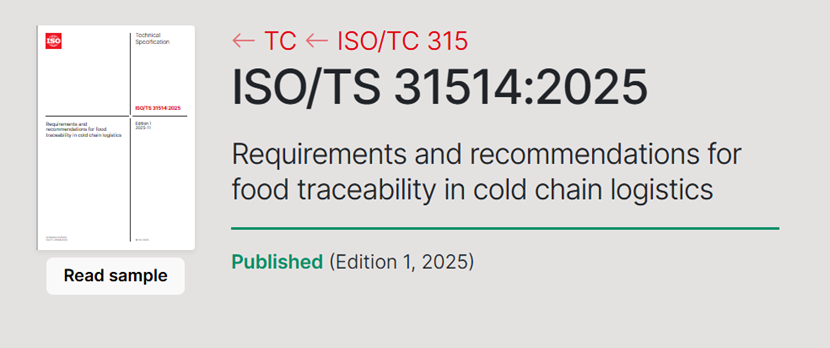
He further emphasized that the release of ISO/TS 31514:2025 marks that Chinese enterprises represented by Yuhu Cold Chain have successfully upgraded domestic advanced cold chain practices and management experience (such as the national standard Management Requirements for Traceability in Food Cold Chain Logistics) into internationally accepted norms. Together with ISO 31511:2024 Technical Specifications for Contactless Cold Chain Logistics and ISO 31512:2024 Service Requirements for B2B Cold Chain Logistics, in which Yuhu Cold Chain was deeply involved in the release, this standard forms an international standard matrix covering three core scenarios of "contactless delivery, B2B services, and food traceability", systematically presenting Chinese solutions to the world.
As a standard setter and practitioner, Huang Zhenghong also shared Yuhu Cold Chain’s "last-mile" implementation to promote the application of standards. Through the path of "localization of international standards + scenario-based implementation in nationwide trading centres", Yuhu Cold Chain has transformed standard requirements into full temperature-zone coverage in hardware and real-time temperature monitoring and traceability throughout the whole process in software at its digital cold storage trading centres such as Yuhu Cold Chain (Guangzhou) Trading Centre and Yuhu Cold Chain (Chengdu) Trading Centre. For example, in September 2024, Yuhu Cold Chain (Guangzhou) Trading Centre obtained international standard system certifications including ISO quality management, environmental management and occupational health and safety management. At the same time, it has actively practiced relevant national standards, and with its high-level digital construction and operation achievements, it was awarded the domestic certification of "Five-Star Digital Warehouse" in October 2025. This strongly proves that international standards can be connected and operated in domestic practices, and can create tangible commercial and social value.
This sharing comprehensively delivered the latest trends of international standardization organizations in the field of cold chain logistics. It provided an important forward-looking reference for Guangdong's logistics standardization work to align with international frontiers and drive the high-quality development of regional logistics industry through standardization. It also demonstrated Yuhu Cold Chain’s professional capabilities and industry influence as a leading enterprise in deeply participating in and leading the formulation of international and domestic standards, stimulating the industry’s confidence and motivation to boost high-quality development through standardization construction.
 Prev
Prev